Welcome to my portfolio!
This month
Pinned
Designing AI Agent Systems for Automotive Supply Chain Operations
Today
Guest Lecturing: Teaching UX Research at Framingham State
This month
Currently: A Web Developer UI/UX Intern at Willkie Farr & Gallagher
This month
Building a macOS app to improve my focus and productivity
1 month ago
Graduating from NYU Tandon as part of the Class of 2025
4 months ago
Studying Dark Patterns Through Gene Editing Interface Design
5 months ago
Fitmaxx, my first iOS app, a fitness app for busy people
4 months ago
An Ethical Redesign of United Airlines Fare Selection
6 months ago
Play my free daily word game, Sliders!
10 months ago
Internal UI/UX research during my internship at Beyer Blinder Belle
11 months ago
Freelance full-stack development for the J.C. Kellogg Foundation
2 years ago
An Ethical Redesign of United Airlines Fare Selection
Mar 4, 2025
Introduction
Dark patterns steer people toward choices that benefit the company more than the traveler. I examined the United Airlines booking flow at the moment a traveler considers Basic Economy. My goal was a more transparent choice without losing clarity or brand voice.
Original Design Analysis
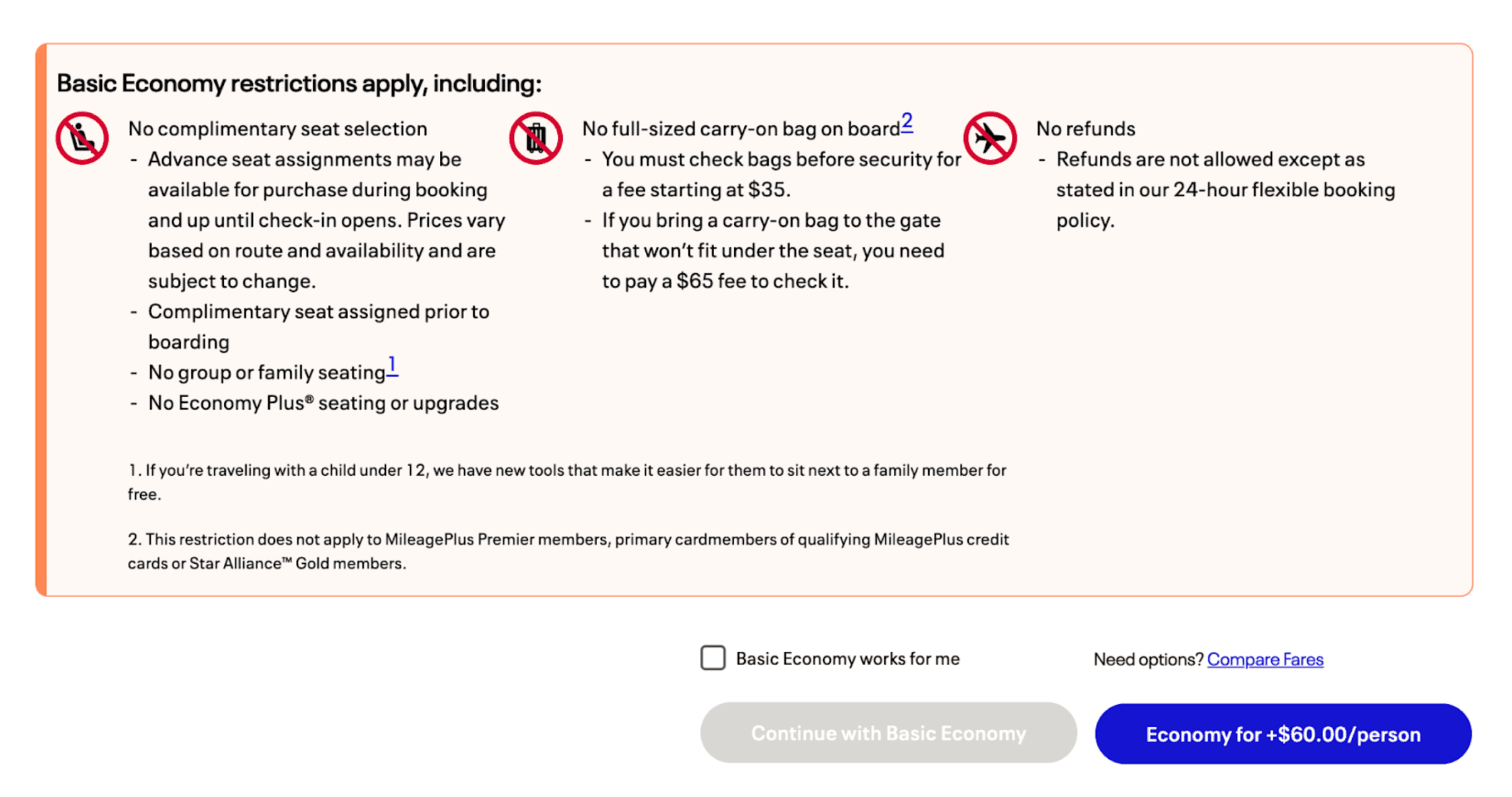
Basic Economy restrictions warning UI with misleading buttons to continue
In the original interface the Basic Economy option is framed through what it lacks. The copy emphasizes restrictions like no complimentary seat selection, no full sized carry on, and no refunds. These lines are paired with red prohibition icons. The color and iconography read like warnings, which primes a user to avoid the option before they consider whether it matches their needs.
Information is presented asymmetrically. The Basic Economy card lists restrictions in detail while there is no equivalent clarity about what the additional cost for Economy actually provides. The interaction introduces friction by requiring the traveler to check that Basic Economy works for me before proceeding, which implies that choosing the cheaper option requires special consideration. The upgrade button also receives visual priority through United’s signature blue while the Basic Economy button is muted.
Hidden fees are emphasized to create anxiety around the lower fare. The interface highlights a potential $35 bag check fee and a $65 gate check fee, which makes the base price feel uncertain and less attractive even before the traveler compares features.
These manipulative practices align with obstruction and preselection, confirmshaming, negative framing, trick wording, and selective emphasis. The likely result is that the traveler spends more while the airline raises revenue, and the decision is shaped by interface pressure rather than a clear assessment of actual needs.
Design Goals
I set a clear standard. Present both options with equal visual weight. Maintain clear feature differentiation. Preserve United’s branding and visual language. Create an intuitive interaction model. Allow informed decision making without manipulation.
Brand Guidelines
The United Airlines brand guidelines showcase a sophisticated yet accessible color palette centered around United Blue (#0054A6) and complemented by Rhapsody Blue, Dusk, Runway Gray, and White. The typography system relies primarily on Helvetica Neue in various weights (Ultra Light, Thin, Light, Roman, Heavy, and Black) with Adobe Bodoni Book as a secondary serif option for select applications. These guidelines establish a cohesive visual language through the airline’s ecosystem, with strict rules for logo usage including appropriate clearspace and color applications, ensuring brand recognition across all customer touchpoints.
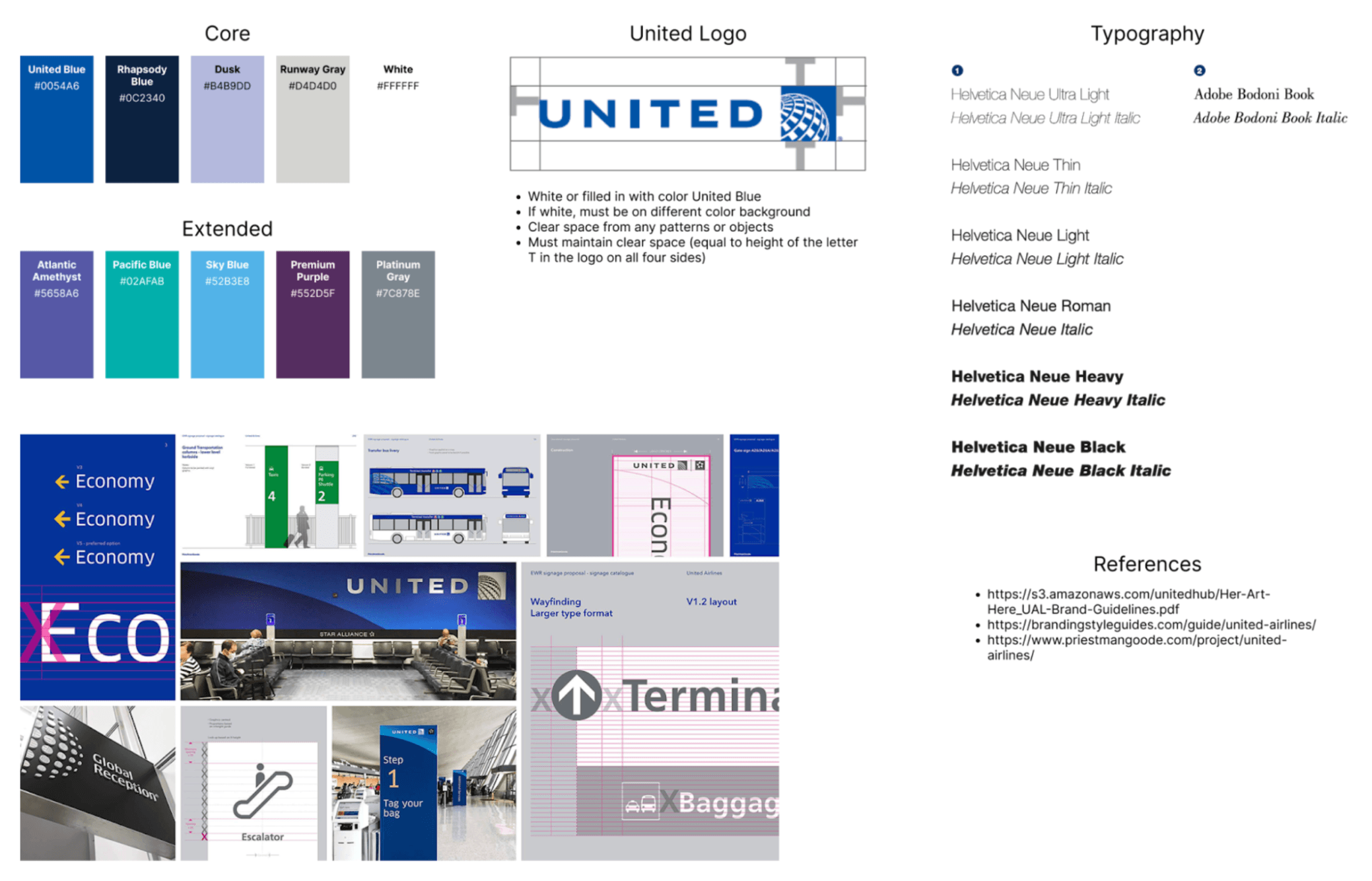
United Airlines Brand Guidelines
A Clear Comparison
| Feature | Basic Economy | Economy |
|---|---|---|
| Seat selection | Assigned at check in | Choose during booking |
| Carry on policy | Personal item only on many routes | Standard carry on allowed where applicable |
| Changes and refunds | Limited flexibility | Greater flexibility per fare rules |
| Boarding | Later boarding groups | Earlier boarding groups |
| Price | Lower base fare | Higher fare for added benefits |
The table is the centerpiece of the redesign. It replaces alarm cues with a factual side by side view. Each row states a practical difference so a traveler can map the rule to a real action like bringing a backpack or selecting seats with friends.
Redesign Showcase
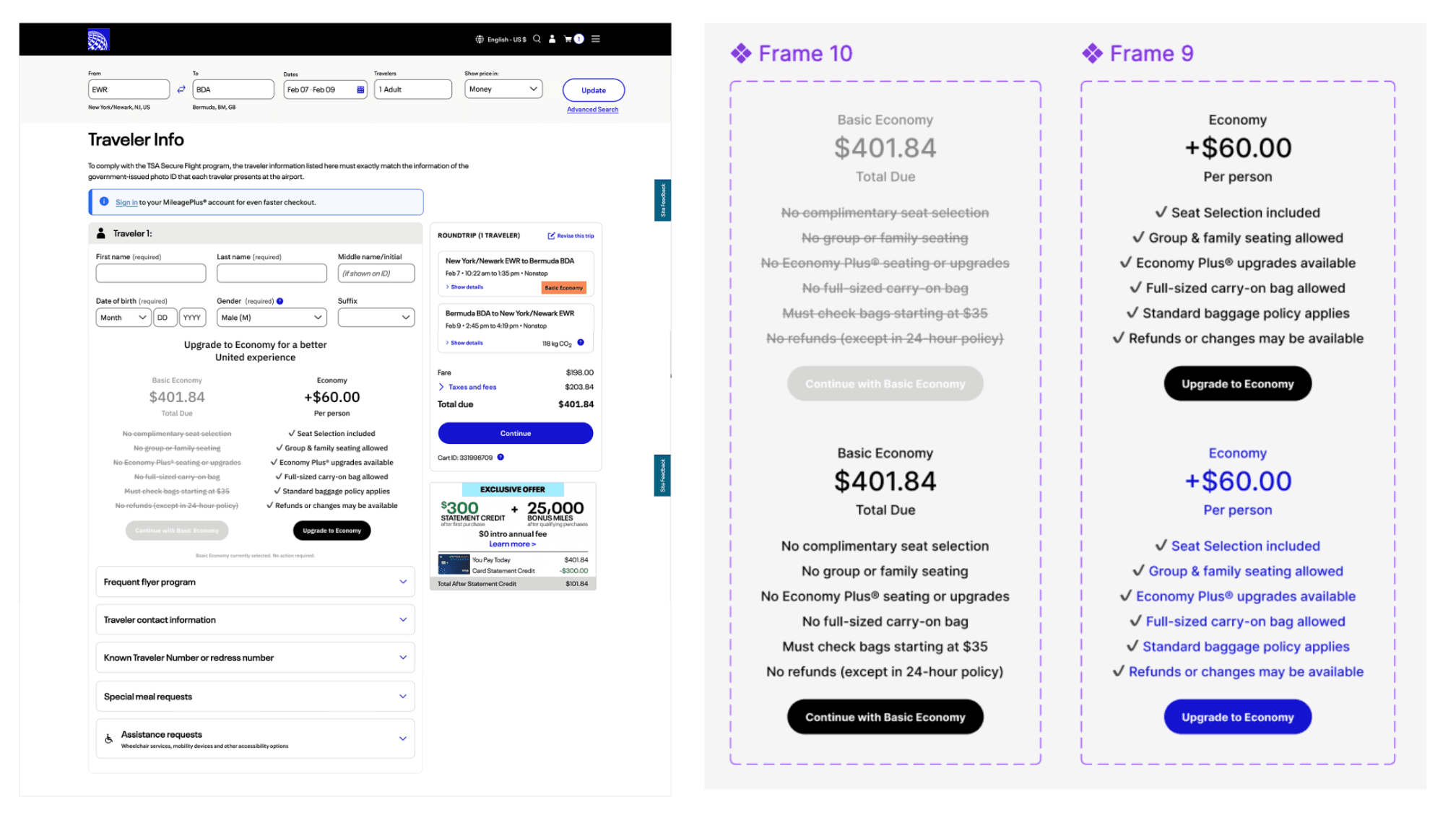
My initial redesign of the fare selection interface
Both fares appear as parallel cards with matched typography and equal button styles. The copy is neutral and specific. Each card describes what the traveler gets rather than stacking warnings. The primary action appears only after a fare is selected, which prevents accidental progress and keeps the focus on understanding the choice first.
Testing Methodology
I conducted usability testing with four university students between 19 and 22 and one middle aged adult. The goal was to observe how first time users interpret the redesigned cards, whether they notice and understand the differences between fares, and how easily they complete the selection without second guessing the interface.
What Users Said
You cannot click these? I thought they would be selectable cards.
Does this mean I cannot bring a backpack at all or just not a roller bag.
It looks nicer but I am probably still going to pick the cheapest one unless I absolutely have to bring a big bag.
Why did it change colors.
I am trying to figure out if it is worth paying extra for a seat assignment.
Revisions Based on Feedback
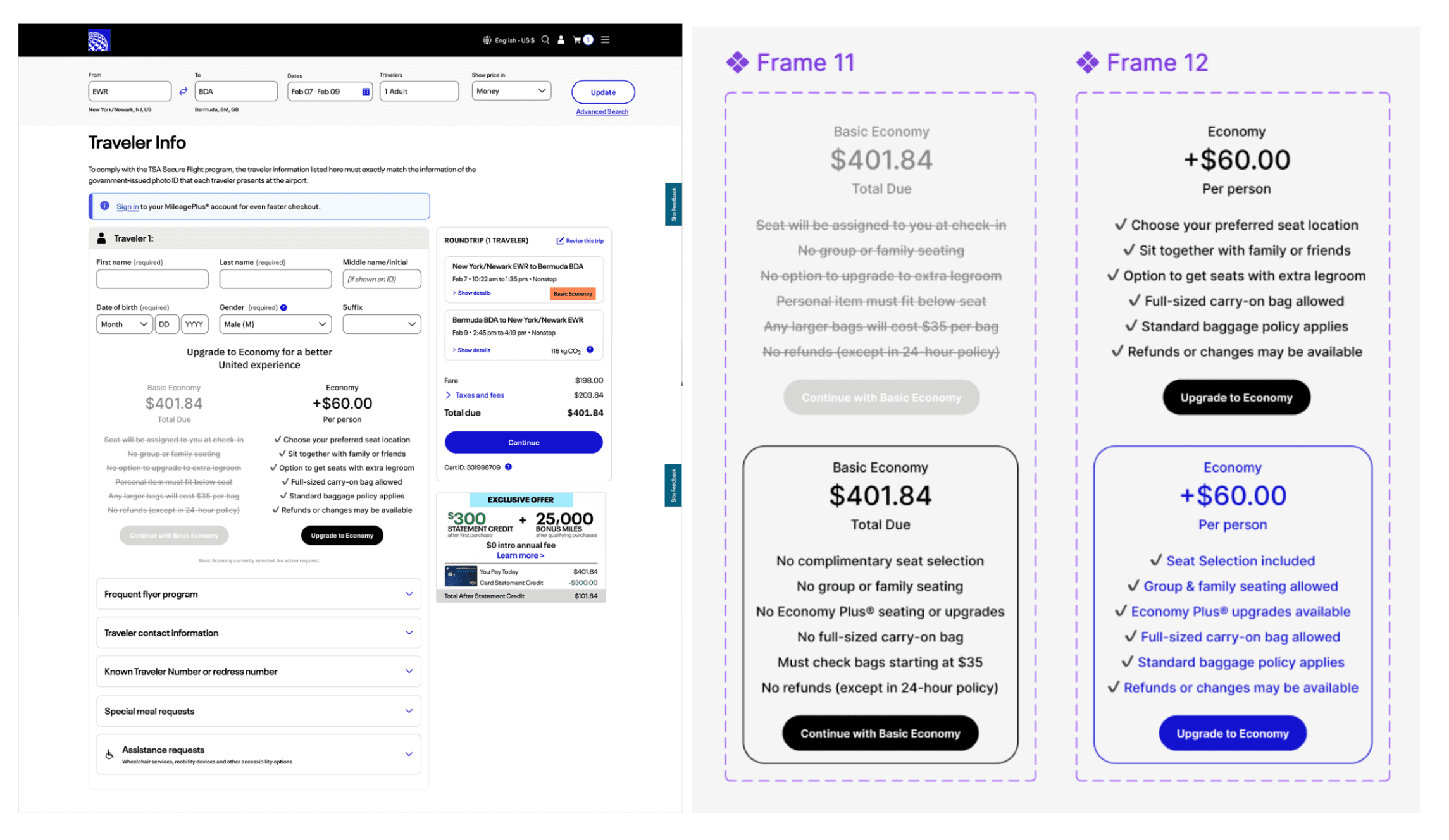
The final design based on feedback from usability testing
I kept every change focused on what participants struggled with during tests and translated those moments into clear improvements.
- Made each card fully clickable so selection matches expectation on first try.
- Added a clear selected state with a checkmark and a defined border so there is no doubt about the active choice.
- Wrote short plain language explanations under airline terms so rules map to real items and actions like bringing a backpack or choosing a seat.
- Refined the hover cue to be gentle and predictable so discovery is immediate without surprise color shifts.
These revisions directly addressed clickable targets, terminology confusion, and hover discovery. After the changes participants selected faster, asked fewer clarifying questions, and expressed more confidence in the choice they made.
Ethical Outcomes
The redesign reduces negative framing and restores balance between fares. Participants reported that they felt informed and less pressured. The interface still communicates why the premium fare costs more, but it does so with clarity rather than fear. Some travelers will still choose only on price. That is honest and expected. It also points to a parallel improvement in transparent pricing that pairs naturally with this interface.
Conclusion
This project shows that it is possible to remove dark patterns and still communicate product differences with precision. Testing exposed a gap between my initial assumptions and real behavior, so I revised the interaction, clarified language, and improved feedback. The result is a booking step that respects user agency, preserves brand standards, and gives a traveler the confidence to pick the fare that matches their trip.
Enjoying this post?
Posted by
Henry Osterweis
Designer & Developer

On this page
2026 Henry Osterweis
How's my portfolio?
😔
🙂
😊