Welcome to my portfolio!
This month
Pinned
Designing AI Agent Systems for Automotive Supply Chain Operations
Today
Guest Lecturing: Teaching UX Research at Framingham State
This month
Currently: A Web Developer UI/UX Intern at Willkie Farr & Gallagher
This month
Building a macOS app to improve my focus and productivity
1 month ago
Graduating from NYU Tandon as part of the Class of 2025
4 months ago
Studying Dark Patterns Through Gene Editing Interface Design
5 months ago
Fitmaxx, my first iOS app, a fitness app for busy people
4 months ago
An Ethical Redesign of United Airlines Fare Selection
6 months ago
Play my free daily word game, Sliders!
10 months ago
Internal UI/UX research during my internship at Beyer Blinder Belle
11 months ago
Freelance full-stack development for the J.C. Kellogg Foundation
2 years ago
Designing AI Agent Systems for Automotive Supply Chain Operations
Dec 12, 2025
Introduction
Artificial intelligence is transforming enterprise operations through autonomous agents that execute complex workflows previously requiring human judgment and coordination. While conversational AI tools offer suggestions and summaries, AI agents represent a fundamental shift toward systems that observe data streams, make decisions based on domain logic, and take action across multiple software platforms without constant human oversight.
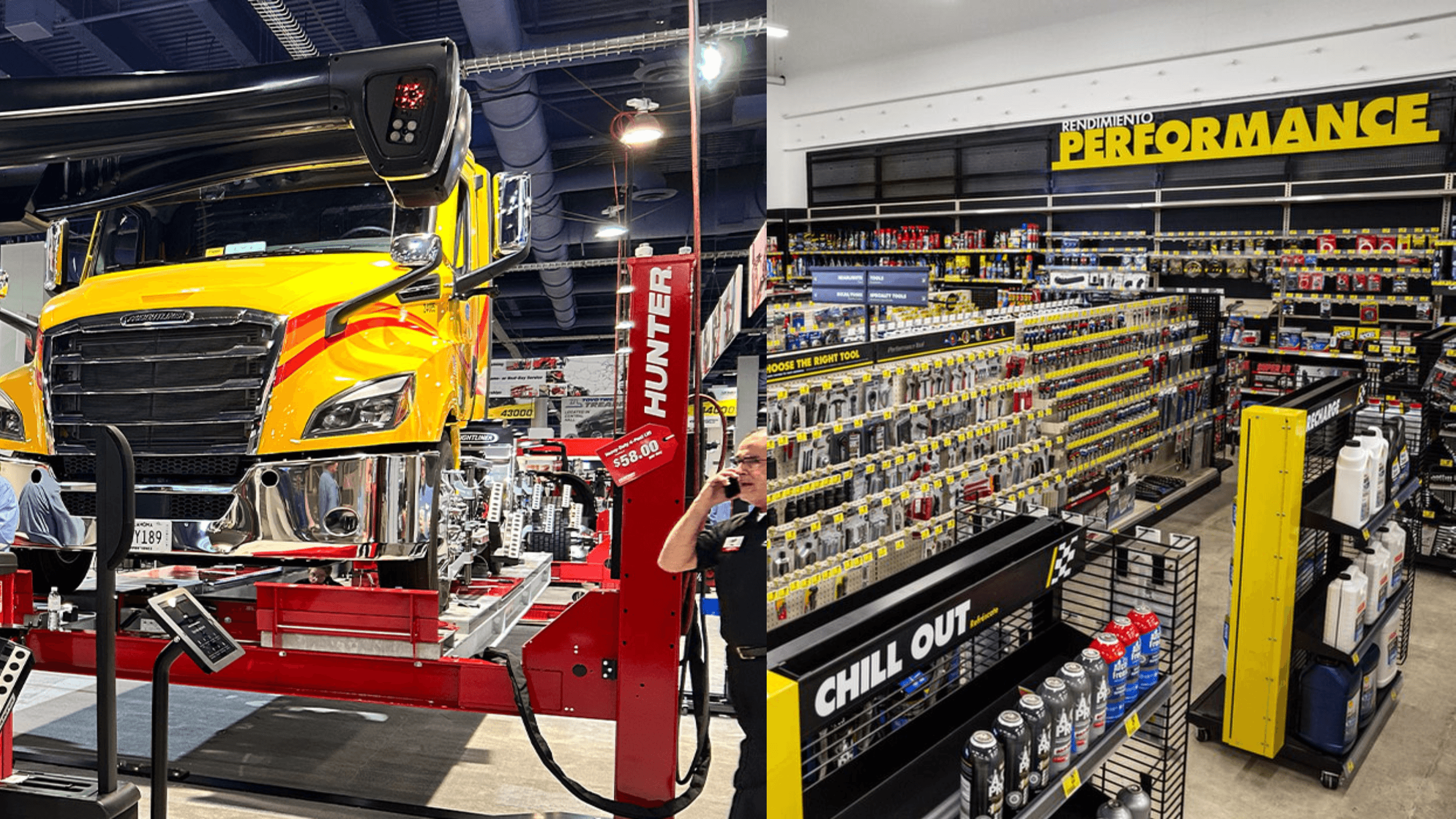
The automotive supply chain presents particular challenges for automation. Equipment manufacturers manage field service operations spanning installation, maintenance, and parts logistics. Auto parts distributors coordinate inventory across hundreds of locations while serving both retail customers and commercial accounts with urgent fulfillment requirements. These environments involve fragmented legacy systems, manual coordination between digital data and physical operations, and workflows where delays directly impact revenue.
This case study examines how AI agent systems could address operational friction in 2 companies within the automotive supply chain. The analysis focuses on workflow decomposition, agent design, and implementation considerations for environments where existing automation approaches have historically failed to deliver meaningful value.
Study Parameters
The objective was to identify opportunities where AI agent systems could deliver measurable operational improvements through intelligent automation and workflow coordination. The scope included 2 companies:
Hunter Engineering Company manufactures advanced automotive service equipment including wheel alignment systems, brake testers, and inspection technologies. The company sells through dealerships, national service chains, and independent repair shops. Their HunterNet 2 platform connects equipment to provide real-time usage data and diagnostic information.
Advance Auto Parts operates as both a retailer and business-to-business distributor of automotive parts. The company serves commercial customers, professional installers, and do-it-yourself buyers through physical stores, distribution centers, and digital channels. Recent investments in warehouse management systems and supply chain analytics indicate ongoing operational transformation.
The analysis required identifying 2 to 3 automation opportunities per company, defining specific AI agents to address those opportunities, documenting system assumptions and technical constraints, proposing implementation approaches, and establishing prioritization logic based on business value and technical feasibility.
Research Approach
The research phase began with examining each company's public-facing information to understand their products, customer segments, and operational model. This included reviewing company websites, product documentation, and customer-facing platforms to establish baseline knowledge of how each business operates.
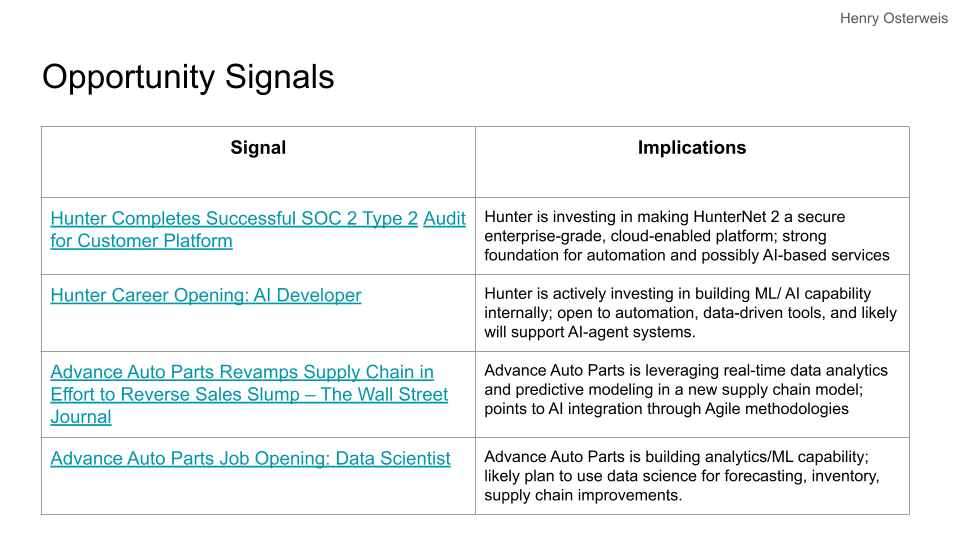
Job postings provided insight into technology investments and organizational priorities. Hunter Engineering's posting for an AI developer indicated active investment in machine learning capabilities and data-driven tools. Advance Auto Parts' data scientist opening suggested plans for predictive analytics in forecasting and inventory optimization. These signals confirmed that both organizations were building internal capability for advanced automation.
Press releases and industry coverage revealed strategic initiatives. Hunter's completion of a SOC 2 Type 2 audit for their customer platform demonstrated commitment to enterprise-grade security and cloud infrastructure. Advance Auto Parts' supply chain overhaul, as reported in The Wall Street Journal, highlighted investments in real-time data analytics and predictive modeling through agile methodologies.
For technology stack assumptions, the analysis considered typical enterprise patterns in each industry. Capital equipment manufacturers often maintain legacy enterprise resource planning systems alongside newer cloud-based customer platforms. Parts distributors typically operate complex multi-system environments spanning warehouse management, point-of-sale, customer portals, and merchandising systems. Where specific vendors could not be confirmed, assumptions reflected common architectural patterns observed across similar companies.
Domain knowledge filled gaps where public information was insufficient. A company selling capital equipment requires coordination across sales, installation logistics, field service dispatch, and spare parts management. A distributor serving commercial accounts must handle complex order routing, credit evaluation, inventory allocation across locations, and exception handling when standard fulfillment paths fail. These operational realities shaped the workflow analysis even where specific process details were not publicly documented.
Workflow Analysis
Hunter Engineering: Proactive Service Through Connected Equipment
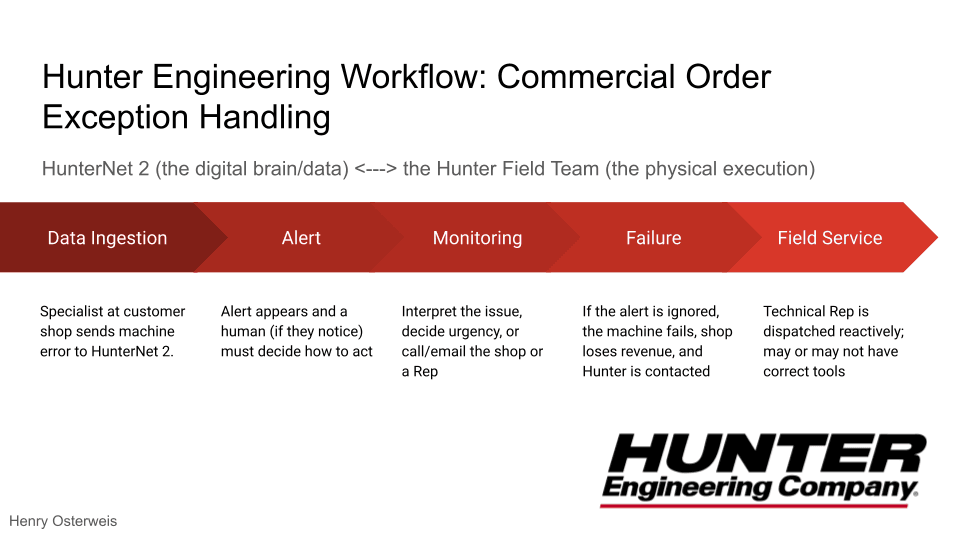
Hunter Engineering's current service alert workflow
Hunter Engineering operates HunterNet 2 as a digital platform that collects real-time data from connected equipment installed at customer locations. This creates a foundation for proactive service, but the current workflow reveals friction between digital monitoring and physical service delivery.
The workflow begins when equipment at a customer shop reports an error or performance anomaly to HunterNet 2. A wheel balancer might log calibration drift. An alignment system might flag unusual vibration patterns. This data appears in a dashboard visible to both the shop manager and Hunter's field organization.
The first friction point occurs at alert monitoring. Shop managers are focused on serving customers and may not actively monitor equipment health dashboards. Alerts can be ignored until equipment failure forces reactive response. When a manager does notice an issue, they must interpret technical diagnostic codes, assess urgency, and decide whether to contact Hunter for service or attempt resolution internally.
If the issue requires Hunter intervention, coordination shifts to the field service organization. A Technical Representative must be identified based on territory and availability. The representative must determine what tools or parts might be needed based on incomplete information. Travel is scheduled reactively rather than efficiently batched with other nearby service calls.
Equipment failure creates the most costly scenario. The shop loses revenue from jobs that cannot be completed. Customer vehicles may be delayed. The shop contacts Hunter with frustration about downtime. A Technical Representative is dispatched urgently, potentially without the correct diagnostic equipment or replacement parts. The visit may require a follow-up trip if specialized components must be ordered.
This workflow demonstrates a classic pattern where valuable sensor data exists but lacks integration with operational systems that coordinate human response. The technical capability to detect problems early is undermined by manual processes that introduce latency and inconsistent follow-through.
Advance Auto Parts: Commercial Order Exception Handling
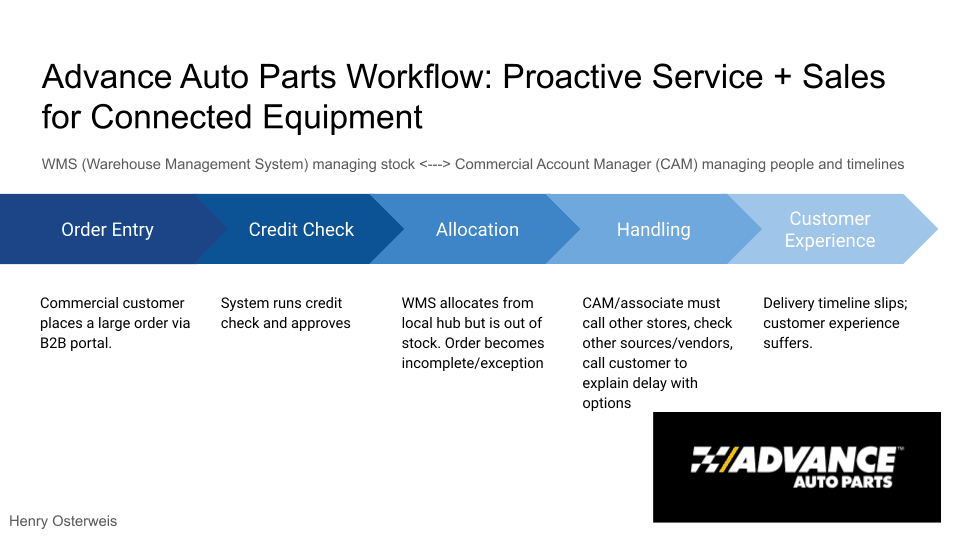
Advance Auto Parts' current order exception workflow
Advance Auto Parts serves commercial customers who require reliable fulfillment of specific parts on tight timelines. Professional installers and repair shops depend on consistent availability to maintain their own customer commitments. The commercial order workflow reveals how system limitations create manual burden and customer friction.
The workflow begins when a commercial account places an order through the business-to-business portal. The customer may be ordering brake components for a scheduled repair job. Timing matters because the installer has made commitments based on expected parts availability.
The system performs a credit check through Advance's Customer First Credit program and validates the customer's account status. Once approved, the order moves to the warehouse management system for allocation and fulfillment planning.
Friction surfaces when the warehouse management system identifies that a required part is out of stock at the local distribution hub. The order becomes flagged as incomplete or exception status. This is where manual intervention becomes necessary.
A Commercial Account Manager receives notification of the exception. The manager must now perform detective work across multiple information sources. They call other nearby stores to check local inventory. They search the system for compatible substitute parts that meet the same specification. They may need to contact vendors who drop-ship certain items. Each of these steps requires separate communication and verification.
While this research is ongoing, the customer's delivery timeline slips. The customer may not be aware of the delay until the Commercial Account Manager contacts them with options. The conversation typically involves explaining what is available, from where, and when it can arrive. The customer must decide whether to accept a substitute, wait for the original part, or potentially source from a competitor.
The workflow demonstrates how rigid routing logic in warehouse management systems creates downstream manual work when reality does not match the planned path. The Commercial Account Manager functions as a human router and problem solver, performing tasks that could be automated if systems had more sophisticated decision logic and cross-system integration.
Agent Design
Hunter Engineering Agents
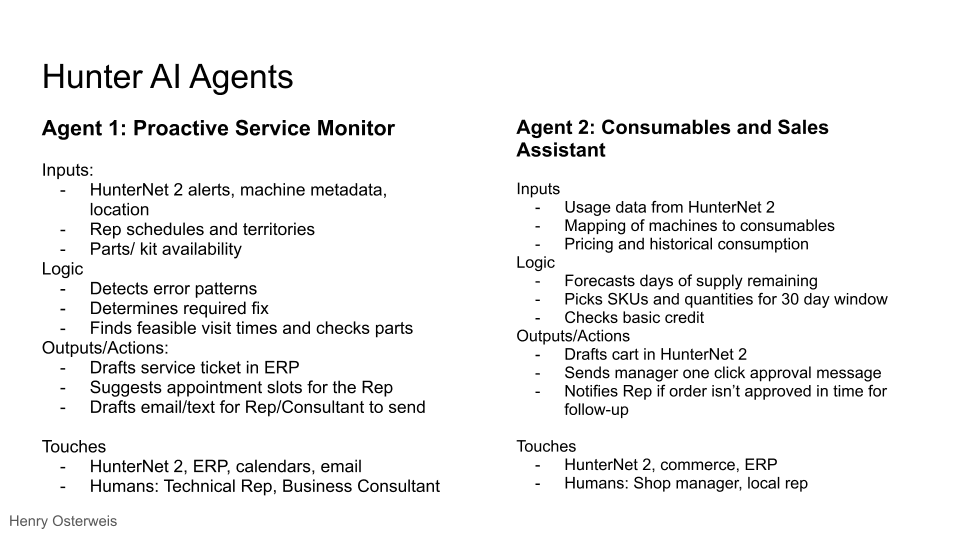
Proposed AI agent system for Hunter Engineering
The first agent addresses the gap between equipment monitoring and field service coordination. The Proactive Service Monitor receives real-time alerts from HunterNet 2, including machine metadata such as equipment type, error codes, and location information. It also accesses Technical Representative schedules, territories, and current parts kit inventory.
The agent's reasoning logic detects error patterns by comparing current alerts against historical failure data. It determines the required fix based on diagnostic codes and equipment specifications. It identifies feasible service visit times by checking representative availability and geographic proximity to other scheduled calls. It verifies whether the representative has necessary parts or calibration tools already in their mobile inventory.
The agent produces several outputs. It drafts a service ticket in the enterprise resource planning system with pre-populated diagnostic information. It suggests specific appointment time slots based on representative availability and customer preferences. It drafts an email or text message that the Business Consultant or Technical Representative can review and send to the shop owner. The message might state that diagnostic data indicates calibration drift and suggest scheduling preventive service before the equipment fails.
This agent interacts with HunterNet 2 for input data, the legacy enterprise resource planning system for ticket creation, calendar systems for availability checking, and email platforms for communication drafts. Human touchpoints include the Technical Representative who reviews the service recommendation and the Business Consultant who may handle customer communication.
The second agent focuses on consumables and recurring revenue. The Consumables and Sales Assistant monitors usage data from HunterNet 2 to track consumption patterns for items like alignment sensors, brake lathe inserts, and calibration supplies. It maintains mapping between equipment types and their associated consumables, along with pricing and historical consumption rates per customer.
The reasoning logic forecasts days of supply remaining based on current usage velocity. It selects appropriate part numbers and quantities to provide a 30-day supply window. It performs basic credit verification before proposing an order. The agent generates a pre-populated shopping cart in HunterNet 2 with recommended reorder quantities. It sends the shop manager a one-click approval message that clearly states the order amount and items. If the order is not approved within a specified timeframe, the agent notifies the local Technical Representative to follow up.
This agent requires access to HunterNet 2 for usage data and commerce functions, and the enterprise resource planning system for pricing and credit checks. The shop manager receives streamlined approval requests while the local representative maintains visibility for relationship management and proactive outreach when automated ordering stalls.
Advance Auto Parts Agents
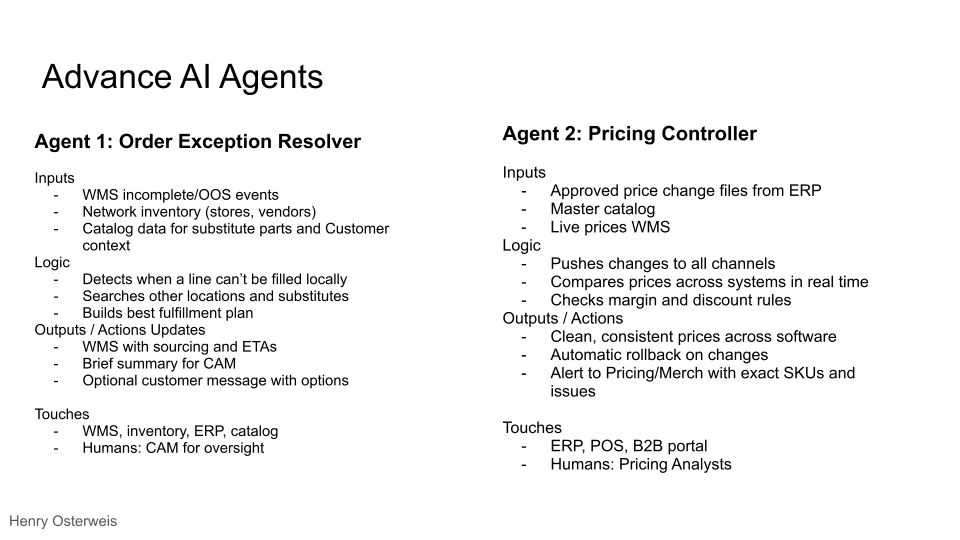
Proposed AI agent system for Advance Auto Parts
The first agent eliminates manual exception resolution. The Order Exception Resolver monitors the warehouse management system for incomplete or out-of-stock events that prevent order fulfillment. It accesses network-wide inventory data across all stores and distribution centers, catalog information for identifying compatible substitute parts, and customer account history showing past purchases and preferences.
The reasoning logic detects when an order line cannot be filled from the planned fulfillment location. It searches alternative inventory sources including nearby stores, other distribution centers, and drop-ship vendors. It evaluates substitute parts based on compatibility specifications and customer history. It constructs an optimal fulfillment plan that minimizes cost and delivery time while respecting customer preferences.
The agent updates the warehouse management system with the new sourcing plan and revised delivery estimates. It generates a concise summary for the Commercial Account Manager explaining how the exception was resolved. For customer-facing communication, it can draft an optional message outlining available options with clear tradeoffs on timing and cost.
This agent integrates with the warehouse management system for order status and inventory updates, the catalog system for part specifications and compatibility data, and the enterprise resource planning system for vendor coordination. The Commercial Account Manager maintains oversight and handles situations requiring judgment beyond the agent's capabilities.
The second agent addresses data consistency across multiple systems. The Pricing Controller receives approved price change files from the merchandising team's enterprise resource planning system. It accesses the master product catalog, current pricing in the warehouse management system, and published prices across customer-facing channels including the point-of-sale system and business-to-business portal.
The reasoning logic pushes price updates to all systems simultaneously to maintain consistency. It performs real-time validation by querying each system after updates to verify prices match the intended values. It checks margin and discount rules to ensure changes comply with business policies.
The agent produces clean, consistent pricing across all software platforms. When it detects discrepancies, it automatically rolls back the affected changes to prevent incorrect pricing from reaching customers. It alerts the pricing team with specific details about which parts failed validation and what discrepancies were found.
This agent touches the enterprise resource planning system for authoritative pricing data, the point-of-sale system used in retail stores, and the business-to-business portal used by commercial customers. Pricing analysts receive exception notifications rather than manually validating thousands of price updates across systems.
System Context and Implementation Considerations
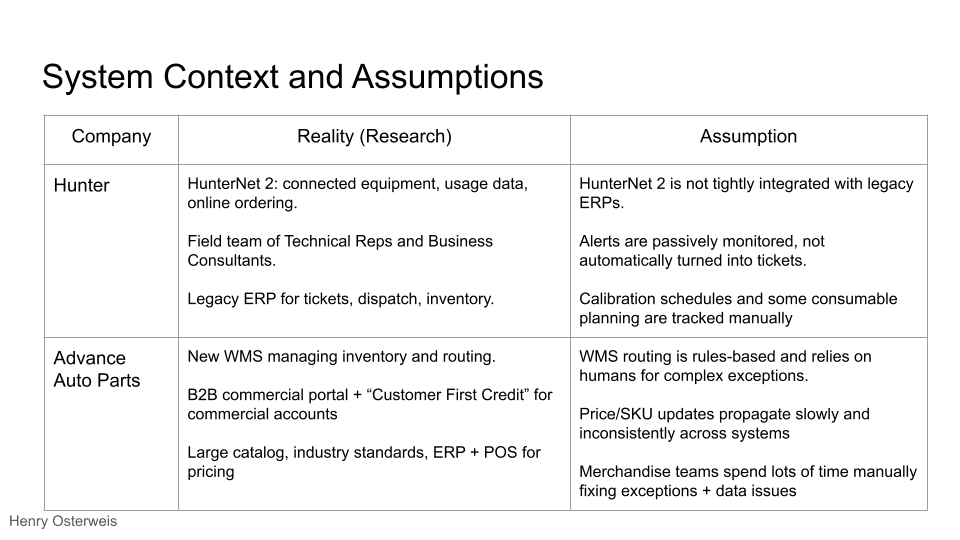
Technology stack documentation and key assumptions
Technology Stack Assumptions
Hunter Engineering operates HunterNet 2 as a cloud-based platform providing connected equipment monitoring, usage analytics, and online ordering for consumables. The SOC 2 Type 2 certification confirms enterprise-grade security controls suitable for integration with AI agent systems. The field organization uses a legacy enterprise resource planning system for service ticket management, dispatch coordination, and inventory tracking.
The key assumption is that HunterNet 2 and the enterprise resource planning system are not tightly integrated. Equipment alerts flow into HunterNet 2 but do not automatically create service tickets or trigger dispatch workflows. Technician scheduling and parts inventory management likely involve manual processes or disconnected tools. This architectural gap creates the opportunity for agent-based integration.
Advance Auto Parts recently upgraded warehouse management infrastructure as part of their supply chain transformation. The company operates business-to-business portals for commercial customers with credit management through their Customer First Credit program. Point-of-sale systems handle retail transactions while enterprise resource planning systems manage merchandising, pricing, and vendor relationships.
The assumptions focus on system fragmentation and data propagation challenges. The warehouse management system likely uses rule-based routing logic that cannot dynamically adapt to complex exception scenarios. Price and product data must flow from enterprise resource planning to warehouse management, point-of-sale, and digital channels, but this propagation may be slow and error-prone. Commercial Account Managers spend significant time manually resolving data inconsistencies and fulfillment exceptions.
Technical Challenges and Mitigation Strategies
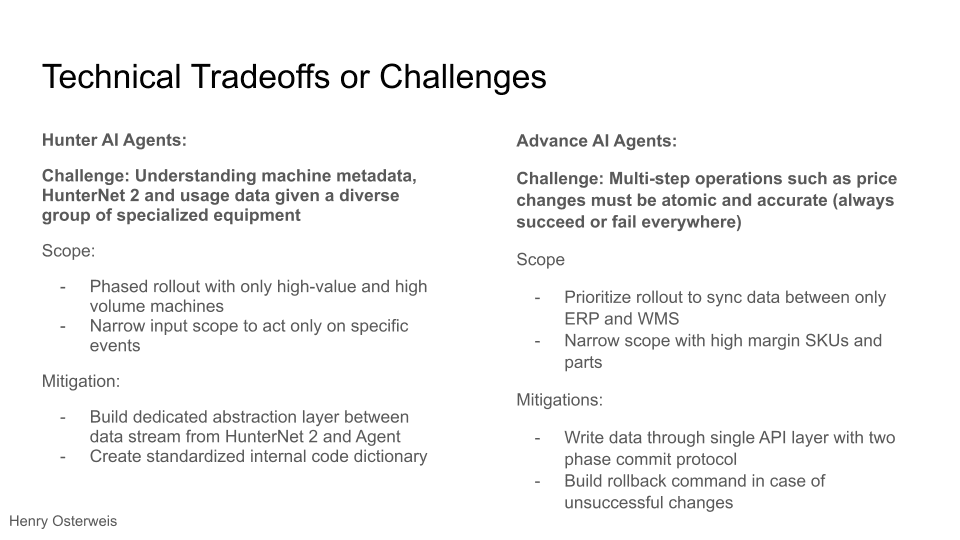
Key technical challenges and proposed mitigation approaches
For Hunter Engineering, the primary technical challenge involves parsing and standardizing diverse machine metadata from HunterNet 2. Different equipment types generate alerts in varying formats with different levels of detail. A wheel balancer logs different error codes and sensor readings than a brake tester. This heterogeneity complicates agent logic that must interpret alerts across the entire equipment portfolio.
The mitigation approach involves phased rollout focused initially on high-volume equipment types that generate the most service calls. By starting with wheel alignment systems and tire balancers, the agent can be developed and validated against a constrained set of alert formats before expanding to other equipment categories. An abstraction layer should be built between HunterNet 2's data stream and the agent to standardize inputs through a common schema. This layer translates vendor-specific error codes into a unified internal vocabulary that the agent processes consistently.
Another consideration is write access to the legacy enterprise resource planning system. Creating service tickets programmatically requires API integration or custom middleware if the system lacks modern interfaces. Starting with read-only implementations that generate recommendations for human review reduces initial integration complexity while proving agent value.
For Advance Auto Parts, the critical challenge is ensuring atomic operations for price updates across multiple systems. Price changes must succeed everywhere or fail everywhere to prevent customers from seeing inconsistent pricing across channels. A partial update where the warehouse management system reflects new prices but the point-of-sale system retains old prices creates immediate customer trust issues.
The mitigation strategy uses a 2-phase commit protocol coordinated through a single API layer that acts as the authoritative source for price updates. The agent sends updates to all systems simultaneously and waits for confirmation before committing changes. If any system fails to acknowledge the update, the agent rolls back all changes and notifies the pricing team. Implementation should begin with a limited scope focusing on synchronization between the enterprise resource planning system and warehouse management system for high-margin parts. This proves the architecture before expanding to include point-of-sale and digital channels.
Data validation is another concern. The agent must verify that price changes comply with margin requirements and do not create situations where Advance would sell below cost. Building business rule validation into the agent logic prevents errors from propagating even when source data is incorrect.
Prioritization Framework
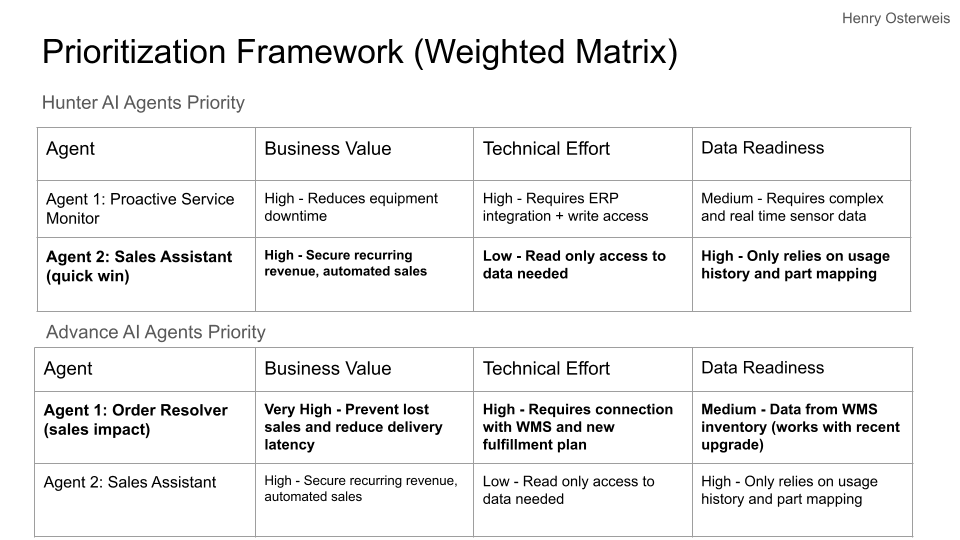
Agent prioritization based on weighted evaluation criteria
The selection of which agents to implement first requires balancing 3 factors: business value, technical feasibility, and data readiness. Business value considers revenue impact, cost reduction, and operational efficiency gains. Technical feasibility accounts for integration complexity, system dependencies, and organizational readiness. Data readiness evaluates whether necessary information already flows through systems in usable form.
For Hunter Engineering, the Proactive Service Monitor offers high business value by reducing equipment downtime and enabling preventive maintenance before failures occur. However, it requires substantial technical effort including enterprise resource planning integration, write access for ticket creation, and handling complex real-time sensor data. The agent must process diverse equipment metadata and coordinate with calendar systems for scheduling. Data readiness is moderate because HunterNet 2 provides the necessary sensor information but additional context about technician capabilities and parts inventory may require new data collection.
The Consumables and Sales Assistant presents an optimal starting point. It delivers high business value through automated recurring revenue from consumable orders while requiring low technical effort. The agent needs only read access to HunterNet 2 usage data and does not require complex enterprise resource planning integration for the initial implementation. Data readiness is high because usage history and parts mapping already exist in accessible form. This makes it the recommended first deployment to establish trust and demonstrate measurable results.
For Advance Auto Parts, the Order Exception Resolver provides very high business value by preventing lost sales and reducing fulfillment delays for commercial customers. Every exception that goes unresolved risks losing that sale to a competitor. The agent requires high technical effort including warehouse management system integration and implementation of fulfillment logic that spans multiple inventory sources. Data readiness is moderate because the warehouse management system provides exception flags and inventory data, but historical patterns for substitute part selection may require additional data collection.
The Pricing Controller offers high business value by ensuring margin protection and data consistency, but it demands lower technical effort than the Order Resolver. Price updates already follow defined workflows, making the agent's role primarily validation and propagation rather than complex decision-making. Data readiness is high because pricing data flows from enterprise resource planning systems in structured format.
Despite the Order Exception Resolver's higher implementation complexity, it should be prioritized first for Advance Auto Parts because exception handling directly impacts commercial customer retention and occurs with sufficient frequency to demonstrate value quickly. Each prevented lost sale provides measurable return on investment that justifies the integration effort.
Analysis and Further Considerations
Failure Modes and Error Handling
AI agent systems must account for multiple failure scenarios where incomplete data, incorrect logic, or execution constraints prevent successful operation. For the Hunter Proactive Service Monitor, critical failure modes include missing machine metadata that prevents accurate diagnosis, incorrect urgency scoring that creates unnecessary service calls, and scheduling conflicts that block proposed appointments even when the diagnosis is correct.
Mitigation requires layered validation. Input validation should immediately flag incomplete alerts and route them to a human review queue rather than attempting to process insufficient information. Urgency scoring should start conservatively, only triggering automated actions for high-confidence patterns validated against historical service records. Time-sensitive actions like appointment scheduling should require human approval until accuracy metrics demonstrate consistent performance.
The Advance Order Exception Resolver faces risk in substitute part selection. The agent might recommend a technically compatible part that specific customers avoid based on quality concerns or installer preference. While the substitution meets specifications, it fails to account for tacit knowledge that Commercial Account Managers have developed through repeated interactions.
The solution involves learning from historical patterns. The agent should initially only suggest substitutes that Commercial Account Managers have previously approved for specific customers. Over time, as confidence builds and the system learns customer preferences, the agent can expand its recommendation scope. Customer feedback loops are essential where managers can mark recommendations as inappropriate with reasons that refine future suggestions.
Stakeholder Impact and Adoption
Successful agent deployment requires understanding how different roles interact with automated systems. For Hunter Engineering, Technical Representatives benefit most from proactive service scheduling because it transforms their work from reactive firefighting to planned maintenance. They gain advance notice of required parts and tools, can batch nearby service calls for routing efficiency, and spend less time on emergency response.
Business Consultants gain time for strategic account development when routine service coordination is automated. Shop managers avoid downtime costs and receive simplified consumable ordering through one-click approvals. However, representatives may initially resist automation if they perceive it as reducing their value or autonomy. Change management must emphasize that agents handle routine coordination while representatives focus on complex diagnostics and customer relationships.
At Advance Auto Parts, Commercial Account Managers experience the most dramatic impact from exception resolution automation. They can manage significantly more accounts when manual inventory searches and vendor coordination are eliminated. However, some managers may prefer maintaining personal relationships through hands-on problem solving. Implementation should preserve manager visibility into agent actions and allow override when judgment requires human nuance.
Pricing analysts shift from manual validation work to strategic pricing decisions and exception investigation. The agent handles high-volume verification while analysts focus on market analysis and margin optimization. This transition requires training on how to interpret agent alerts and when to intervene.
Measurement and Continuous Improvement
Defining success metrics establishes accountability and guides ongoing refinement. For the Hunter Proactive Service Monitor, operational metrics include mean time to alert resolution with a target reduction of 50%, percentage of alerts that reach resolution without human escalation, and equipment uptime improvement measured against historical baselines. Business metrics track service contract renewals and correlation with proactive maintenance adoption. Agent-specific metrics monitor what percentage of tickets are auto-generated and how frequently humans must override agent recommendations.
The Consumables and Sales Assistant should track order completion rate, average time from low-inventory detection to approved reorder, and revenue from automated consumable sales compared to historical manual ordering patterns. Customer satisfaction scores from shop managers provide qualitative feedback on whether the automation adds value or creates friction.
For the Advance Order Exception Resolver, operational metrics focus on exception resolution time with a target under 5 minutes compared to 30+ minutes for manual resolution, percentage of orders fulfilled on first pass without exceptions, and order cancellation rate. Customer satisfaction from commercial accounts validates whether automated resolution maintains service quality. Agent metrics include successful substitution rate and frequency of Commercial Account Manager intervention.
The Pricing Controller measures pricing discrepancies caught before customer impact, rollback frequency indicating data quality issues in source systems, and time required for price updates to propagate across all channels. Alert response time by pricing analysts helps identify whether the agent's notification system provides actionable information.
These metrics should be reviewed weekly during initial deployment and monthly once operations stabilize. Trends indicating degraded performance trigger investigation and retraining. Sustained improvement demonstrates value and justifies expansion to additional use cases.
Expansion Pathways
Expansion pathways for the initial agents
Once initial agents demonstrate value, natural extensions emerge. For Hunter Engineering, after consumable ordering automation succeeds, a preventive maintenance scheduler becomes viable. This agent would analyze usage patterns from HunterNet 2 to predict when equipment will drift out of calibration based on historical performance curves. Rather than waiting for errors, it schedules calibrations before precision degradation affects shop operations.
Multimodal capabilities could allow technicians to photograph broken components and receive instant identification with part numbers and availability. This reduces diagnostic time in the field and ensures correct parts are ordered on first attempt.
For Advance Auto Parts, successful exception resolution enables demand forecasting agents that predict which parts will experience stockouts based on historical ordering patterns, seasonal demand, and local market trends. Proactive inventory positioning prevents exceptions from occurring rather than resolving them reactively.
Dynamic pricing optimization represents another extension where agents monitor competitor pricing, inventory levels, and customer order history to suggest margin-safe price adjustments that maximize competitiveness while protecting profitability.
The pattern across both companies is that agents build on each other. Early deployments establish integration patterns, build organizational trust, and create data foundations that make subsequent agents easier to implement. Each successful agent expands the realm of what can be automated while preserving human judgment for situations requiring creativity, empathy, or complex tradeoff analysis.
Conclusion
This analysis examined how AI agent systems could address operational friction in automotive supply chain environments where traditional automation approaches have proven insufficient. By decomposing specific workflows at Hunter Engineering Company and Advance Auto Parts, the study identified opportunities where agents could execute complex judgment-based tasks across fragmented system landscapes.
The Hunter Engineering use cases demonstrated how connected equipment data remains underutilized when integration gaps prevent automated response to service needs and consumable reordering. The Advance Auto Parts scenarios revealed how rigid warehouse management logic creates manual exception handling burden that scales poorly as order volume grows.
The agent designs prioritized clear input-output definitions, explicit reasoning logic, and integration points that work within existing system constraints rather than requiring wholesale replacement. Technical challenges focused on data standardization, atomic operations, and phased implementation approaches that prove value before expanding scope.
The prioritization framework identified quick wins with the Hunter Consumables and Sales Assistant and high-impact opportunities with the Advance Order Exception Resolver. Both represent scenarios where business value justifies implementation effort and where success can be measured through concrete operational metrics.
AI agents represent a shift from suggesting actions to executing workflows autonomously while maintaining human oversight. In supply chain operations where timing directly impacts revenue and customer satisfaction, this capability transforms how companies coordinate between digital systems and physical operations. The patterns identified in these automotive supply chain applications extend to other industries facing similar challenges of system fragmentation, manual coordination, and workflows that require judgment rather than simple rules.
Understanding how to design, implement, and measure AI agent systems will define competitive advantage as these technologies mature. The companies that successfully deploy agents will gain operational leverage that compounds over time as each implementation makes subsequent automation easier. Those that treat agents as incremental improvements to existing processes rather than fundamental capability shifts risk falling behind competitors who recognize the strategic opportunity.
Enjoying this post?
Posted by
Henry Osterweis
Designer & Developer

On this page
2026 Henry Osterweis
How's my portfolio?
😔
🙂
😊